Spatial Sight
You are not asked to believe. You are asked to record.
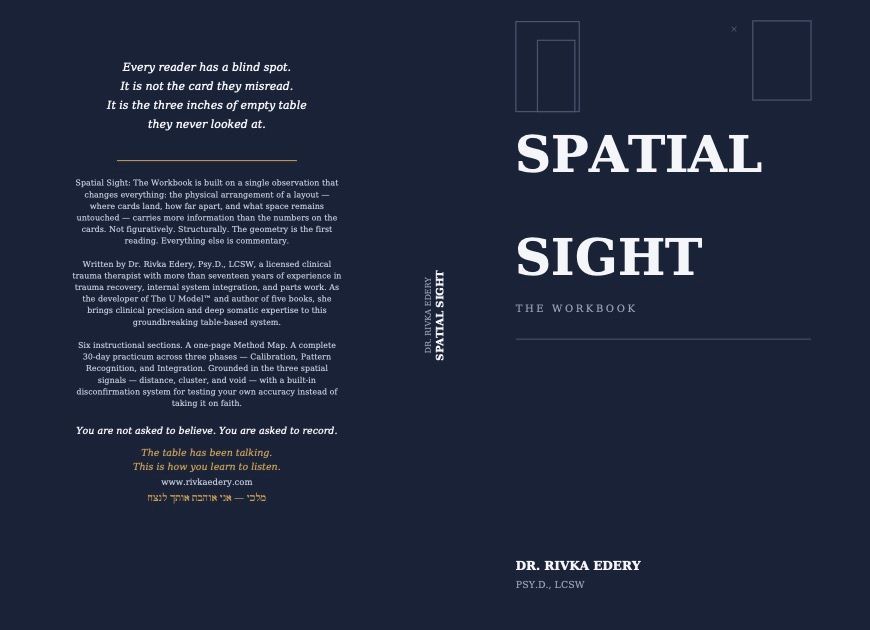
Every reader has a blind spot. It is not the card they misread — it is the three inches of empty table they never looked at.
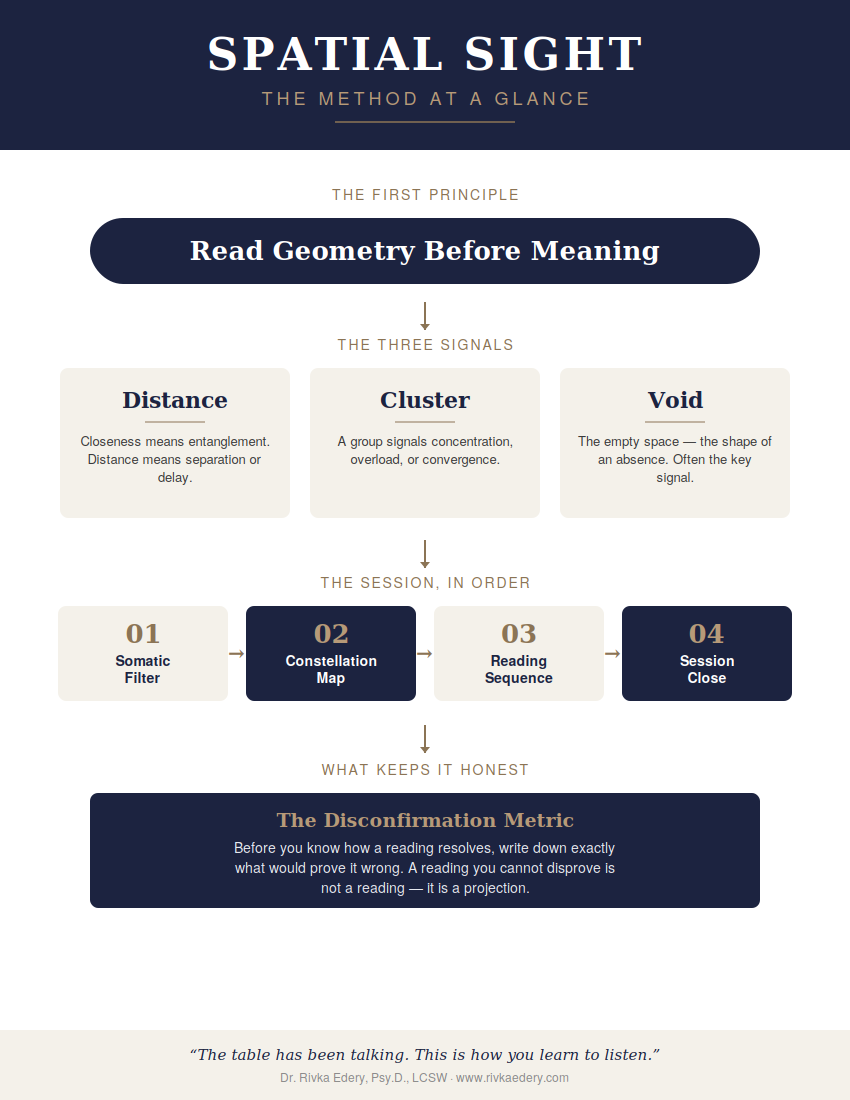
Spatial Sight is built on a single observation that changes everything: the physical arrangement of a layout — where cards land, how far apart, and what space remains untouched — carries more information than the numbers on the cards. Not figuratively. Structurally. The geometry is the first reading. Everything else is commentary.
The table has been talking. This is how you learn to listen.
Spatial Sight: The Workbook
The complete method, in 372 pages. Six instructional sections, a one-page Method Map, and a full 30-day practicum across three phases — Calibration, Pattern Recognition, and Integration. Grounded in the three spatial signals — distance, cluster, and void — with a built-in disconfirmation system for testing your own accuracy instead of taking it on faith.
You are not asked to believe. You are asked to record.
Guided Video Lessons
Watch Dr. Rivka Edery guide you through Spatial Sight.
Watch on YouTube → https://www.youtube.com/@DrRivkaEdery
Start with the Welcome & Introduction video, then follow the complete guided series.
Spatial Sight: The Practice Log
Prediction Threads · The Deck Vocabulary
The working companion to the Workbook — the record where the method meets the evidence.
600 numbered prediction threads and a 384-line, two-pass Deck Vocabulary.
Works with any deck: oracle, playing, tarot, or the Spatial Sight Method Deck.
The discipline is simple and absolute: log the question and the felt signal before the outcome is known. Rate your confidence. Close the book. Score it only when reality answers —
Hit, Miss, Partial, or Void — with no retroactive entries and no reinterpretation.
Every hit will flatter you. Every miss will teach you. A log with only hits in it is not a record — it is a highlight reel.
The signal was already arriving. This is where you write it down.
Start with a Free Session
Get the Live Field Session handout free — a complete, printable worksheet that walks you through one full reading, from somatic baseline to disconfirmation. Enter your email and it's yours.
Get the Free Handout:
About Dr. Rivka Edery
Dr. Rivka Edery, Psy.D., LCSW, is a licensed clinical trauma therapist with more than seventeen years of experience in trauma recovery, internal system integration, and parts work.
She is the developer of The U Model™ and the author of several books on trauma and healing, including
Between Self and Parts: A 30-Day Journey of Self-Discovery with The U-Model™: ACT & IFS,
Spatial Sight: The Workbook, and its companion,
Spatial Sight: The Practice Log — Prediction Threads · The Deck Vocabulary.
She brings clinical precision and deep somatic expertise to this groundbreaking table-based system.
© 2026 Dr. Rivka Edery, Psy.D., LCSW · www.rivkaedery.com
Frequently Asked Questions
Honest answers to the questions skeptics ask first.
Spatial Sight is a method for reading the geometry of a card layout — where cards land, how far apart, and what space stays empty — before assigning any meaning. It is designed to be tested, not simply believed. Here are the questions I hear most often.
The Method & Philosophy
Isn't this just cold reading, or the “Barnum effect”?
It's a fair question, and in a sense it's the whole point. The Barnum effect is why vague statements can feel personal. Spatial Sight is built to fight exactly that in two ways:
1) You commit the layout to paper before you know what any card is, and
2) You write down, in advance, what would prove your reading wrong.
Vagueness cannot survive that kind of record.
Are you claiming the cards are supernatural?
No. You do not have to accept any supernatural claim to use this. Spatial Sight works as a disciplined observation and structured self-reflection practice — a way to externalize patterns and force honest, dated records. It functions as that regardless of what anyone believes about anything else.
How could where the cards land possibly mean anything?
The arrangement is partly produced by you — how you handle and place the cards.
Think of it as a projective surface, like an inkblot, but governed by a strict protocol that keeps you honest about what you actually observed versus what you added afterward. The discipline is doing the work, not the cardboard.
You keep using the word “geometry.” Is this actually mathematics?
No, and I won't claim it is. Geometry is a lens: its structure — point, distance, cluster, plane — maps cleanly onto how the method reads a layout. It is a structural analogy that happens to hold at every joint. Judge it as a useful analogy, not as a theorem.
Isn't “the empty space has meaning” just reading into nothing?
It would be, without the controls. But you record the layout first and state in advance what would prove your reading of the empty space wrong. Reading absence is standard in serious fields — astronomers detect unseen planets by their gravitational pull; radiologists read the negative space on a scan. The discipline is what separates reading an absence from inventing one.
How is any of this falsifiable?
This is the part I care about most. Every reading requires a disconfirmation metric — written in advance — that names exactly what observable events would prove it wrong.
If nothing could prove a reading wrong, then it is projection, and the method is designed specifically to prevent that.
Why should I trust “somatic signals” in my hands?
You don't have to treat them as magic. Treat them as a structured way to slow down and notice your own involuntary micro-reactions.
Remember the built-in check: the moment you catch yourself reaching for a card out of preference rather than sensation, you stop. The method is designed to catch its own operator.
Science & Skepticism
Is there actual scientific evidence that this works?
Let me be direct: I am not claiming peer-reviewed, controlled-trial proof that Spatial Sight predicts outcomes. It would be dishonest to imply that it exists. What I am offering is a disciplined framework built so that you can test it honestly on your own — recording readings in advance, logging the misses as faithfully as the hits, and stating beforehand what would prove a reading wrong. In other words, I am not asking you to trust my evidence; I am handing you the tools to gather your own and to see plainly whether it holds up for you. A method that told you it could not fail would be the one to distrust. This one is built to fail — and to show you if it does.
What if two people read the same layout differently?
That is exactly why the fixed reading sequence and the named patterns exist — to reduce that spread. And it is testable: give two trained readers the same recorded layout and compare.
A method that produced wildly different readings every time would be failing its own standard, and I would want to know.
Getting Started & Practicum
Do I need any experience to learn this?
None at all — and in some ways, no experience helps. You do not need to memorize the meaning of a single card. The method teaches you to read arrangement first, which is a skill anyone can practice from day one using the 30-day practicum.
What do I actually need to get started?
Any deck of cards — oracle, playing, tarot, or the Spatial Sight deck — something to write on, and a willingness to record honestly, including the misses. Everything else is in the workbook and the course.
Logistical & Support Questions
Do I need to buy both the Workbook and the Practice Log?
The Spatial Sight Workbook provides the full methodology, instructions, and instructional exercises. The Practice Log is a specialized, 600-entry companion designed specifically to record your daily prediction threads and build your personal deck lexicon over time. You can start with the Workbook alone, but the Log is recommended for practitioners who want a dedicated space to track long-term accuracy and deck vocabulary.
How can I get support if I’m having trouble with the method?
Spatial Sight is designed as a self-guided practice space. If you need further guidance, you can review the Method Map and FAQs on this website. For more complex inquiries or clinical support, you may contact Dr. Rivka Edery directly through www.rivkaedery.com.
Join our Thursday Mediumship Circle Facebook Group:
https://www.facebook.com/share/g/1CPMDDnrvw/?mibextid=wwXIfr
Register for our FREE monthly practice group:
https://us06web.zoom.us/meeting/register/tZckcOugqjgrHdE64_TUvZZx82batndiUbqb
Do you offer professional training or certification?
Currently, the methodology is taught through the published Spatial Sight materials.
For updates on future workshops, advanced training opportunities, or professional consulting, please subscribe to the newsletter at www.rivkaedery.com.
Dr. Rivka Edery, Psy.D., LCSW · www.rivkaedery.com