Selected Publications
Edery, R. (2026). The wound you can’t medicate: Why social workers must distinguish moral injury from PTSD.
Social Work Advocates.
This feature article, published by the National Association of Social Workers (NASW), explores the somatic and psychological distinctions between trauma-based PTSD and the "soul wound" of moral injury. It introduces the U-Model™ framework as a clinical protocol for moving clients from shame-based reactivity into a state of Self-led workability.
→ Access Full Article via NASW: https://www.socialworkers.org/News/Social-Work-Advocates)
The U-Model™ Masterclass: Framework Innovations
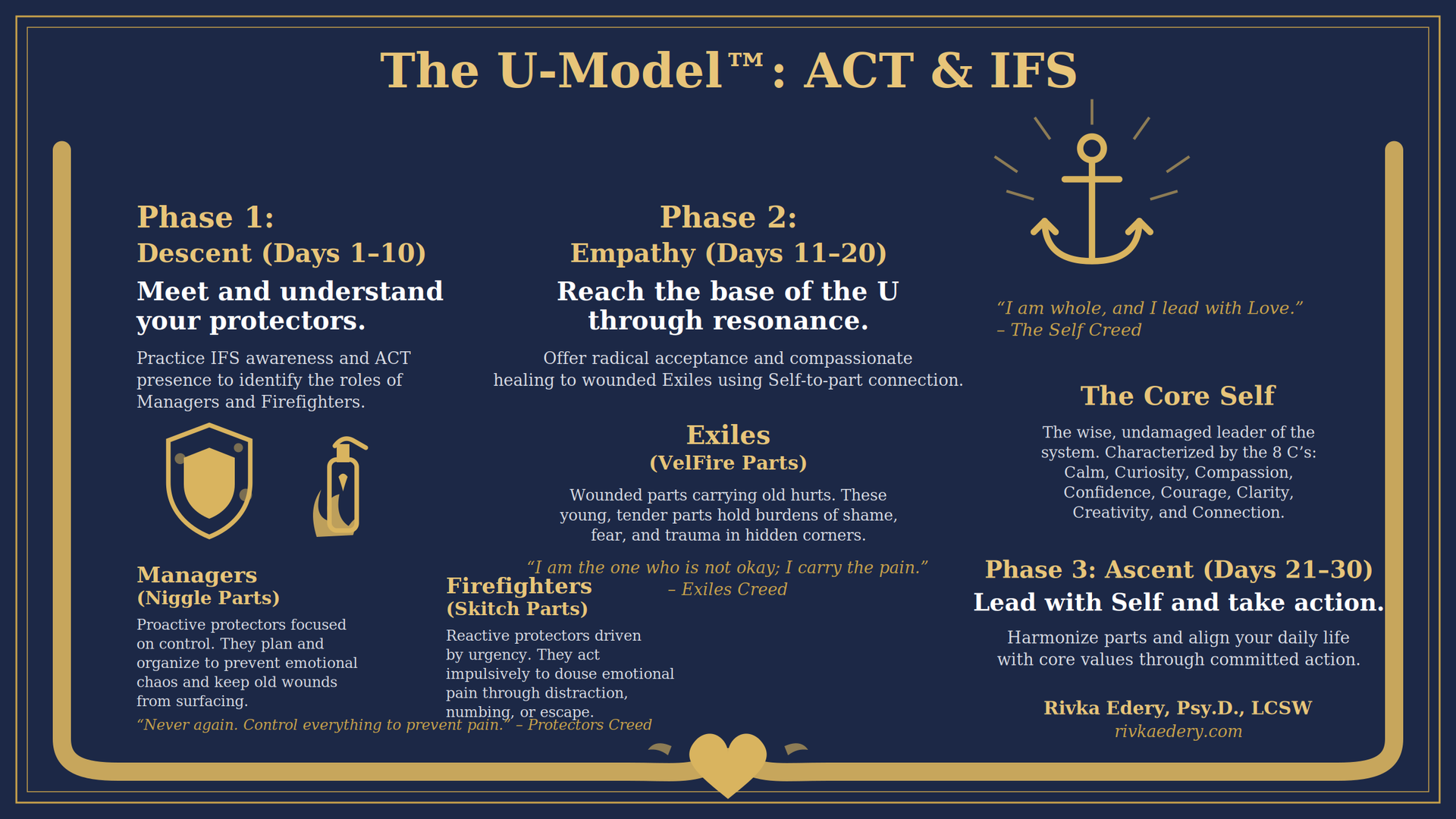
The U-Model™: Lead Your Parts Toward Psychological Flexibility
An IFS & ACT Framework for Self-Leadership and Internal Workability.
In this 100-minute masterclass, Dr. Rivka Edery demonstrates how to bridge Internal Family Systems (IFS) and Acceptance and Commitment Therapy (ACT) into a singular, actionable protocol. By utilizing the Rosetta Stone Dial, you will learn to facilitate a shift from part-led reactivity to a state of Self-as-context. This process allows burdened parts to release rigid protective patterns, developing the psychological flexibility required for the Self to lead the system toward internal workability.
Welcome to the Edery House Press Digital Vault.
Presence is the prescription. As you begin this 01:41:33 session, I invite you to settle into your Self-leadership. This space is a container for witnessing the 'heroic intent' of your parts while providing the compassionate authority they need to thrive. This is not about 'fixing'—it is about the Self-as-context expanding its capacity to hold the distress of burdened parts, allowing for a profound shift in how your internal system relates to its own history and functions in the present.
Meet the characters of The U-Model™ — Niggle, Skitch & VelFire →https://www.rivkaedery.com/meet-the-parts
The Resource Vault
The following protocols are designed to anchor the Self-to-Part connection and facilitate Internal Workability:
- Evidence-Based Clinical Efficacy
- Curiosity Audit
- 30-Day Journey Calendar
- Ascent Action Plan
These tools are designed to anchor the Self-to-Part connection and facilitate functional movement within your internal system.
The Empirical Foundation
The U-Model™: Bridging Intra-Psychic Parts and Behavioral Functionality
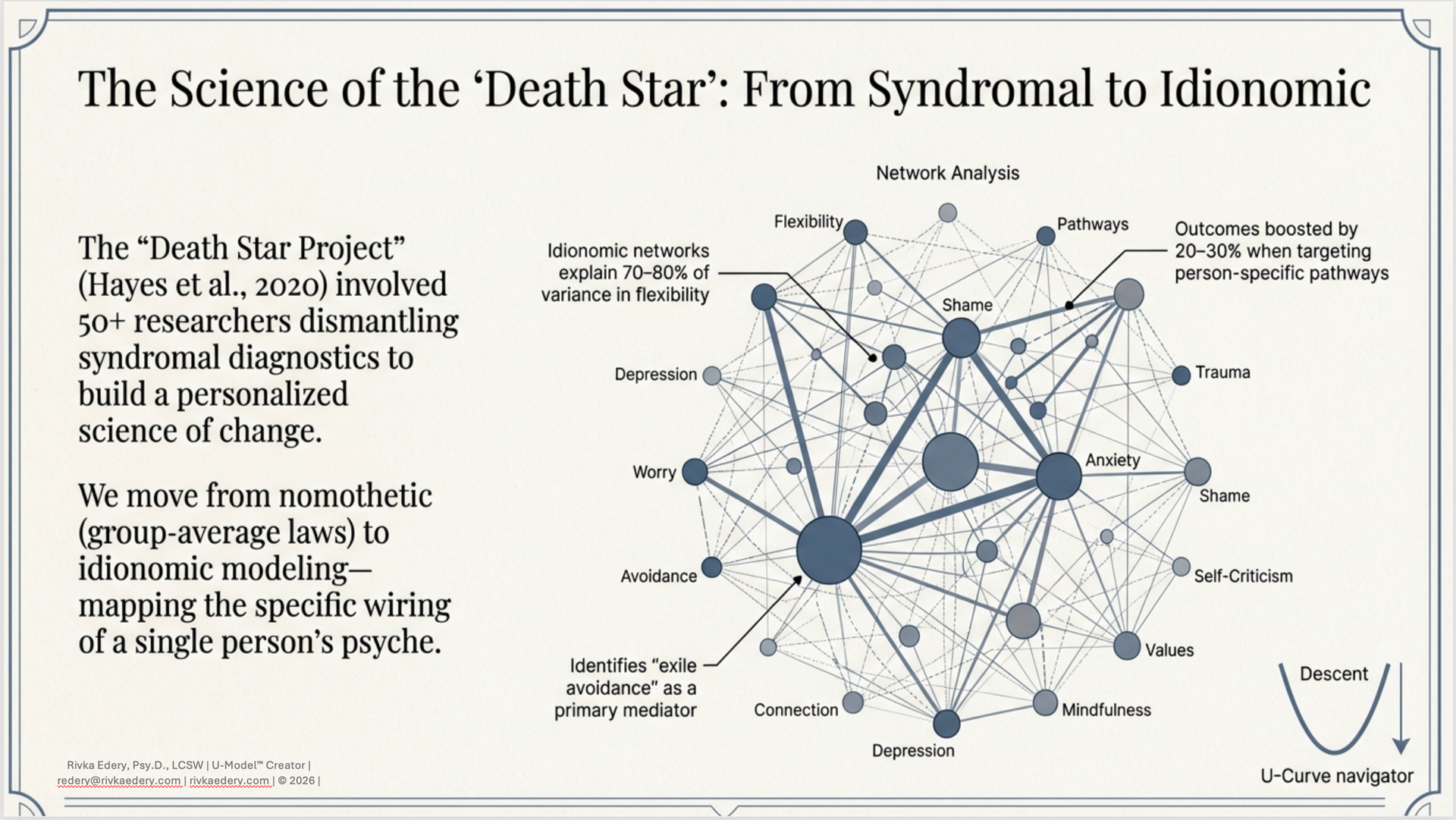
Clinical innovation cannot exist in a vacuum. While many models rely on intuition, The U-Model™ is engineered to align with the universal mechanisms of human change. This framework was developed as a direct response to the "Death Star Project" - the landmark meta-analysis by Hayes et al. (2020), which synthesized tens of thousands of studies to identify the specific mediators of clinical improvement.
The data are unequivocal: therapeutic success is not a product of "branding," but of targeting core mediators such as psychological flexibility and affective regulation.
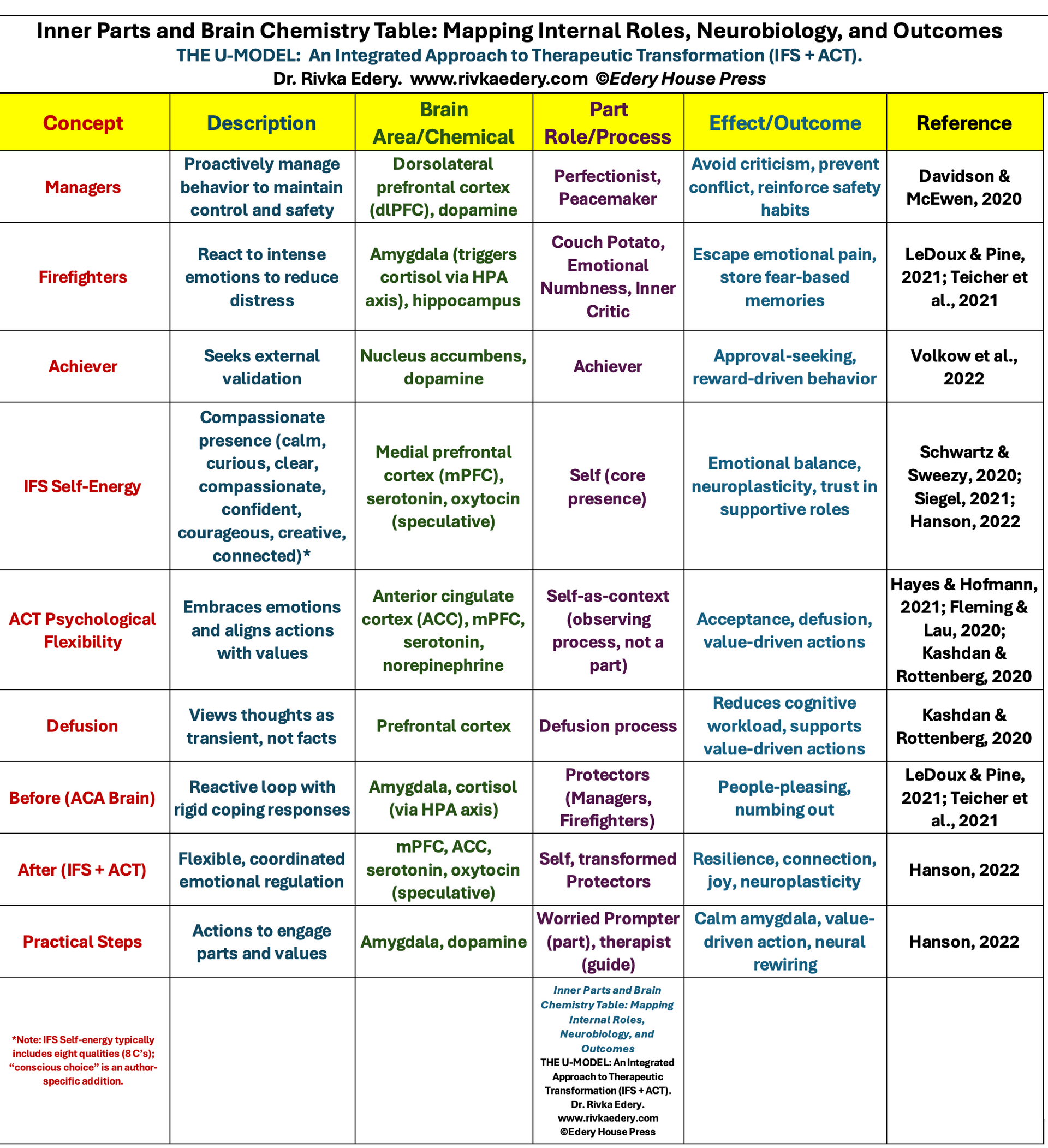
The U-Model™ serves as a visual, process-based application of these findings. By mapping the descent from trauma-driven reactivity to the values-based ascent, the framework allows clinicians to:
- Identify the "Inner Platoon" of protective parts (IFS).
- Track mediators of change in real-time.
- Ensure that deep parts-work remains anchored in the rigorous science of Process-Based Therapy (PBT).
This integration ensures that "Self-energy" is not just felt - it is functionally applied through Committed Action, transforming unburdening into a measurable change in the client's life.
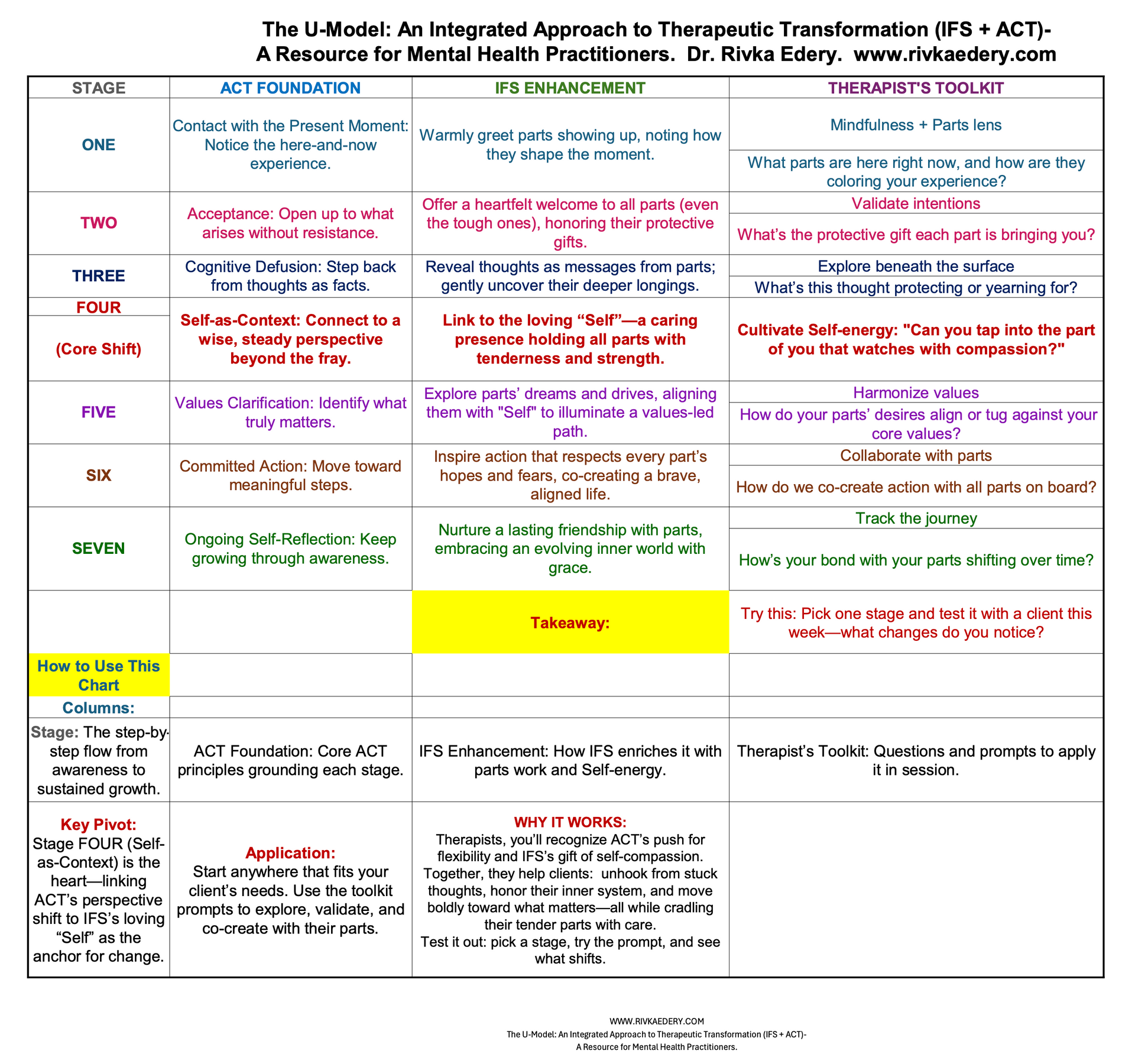
The 7-Stage Structural Protocol
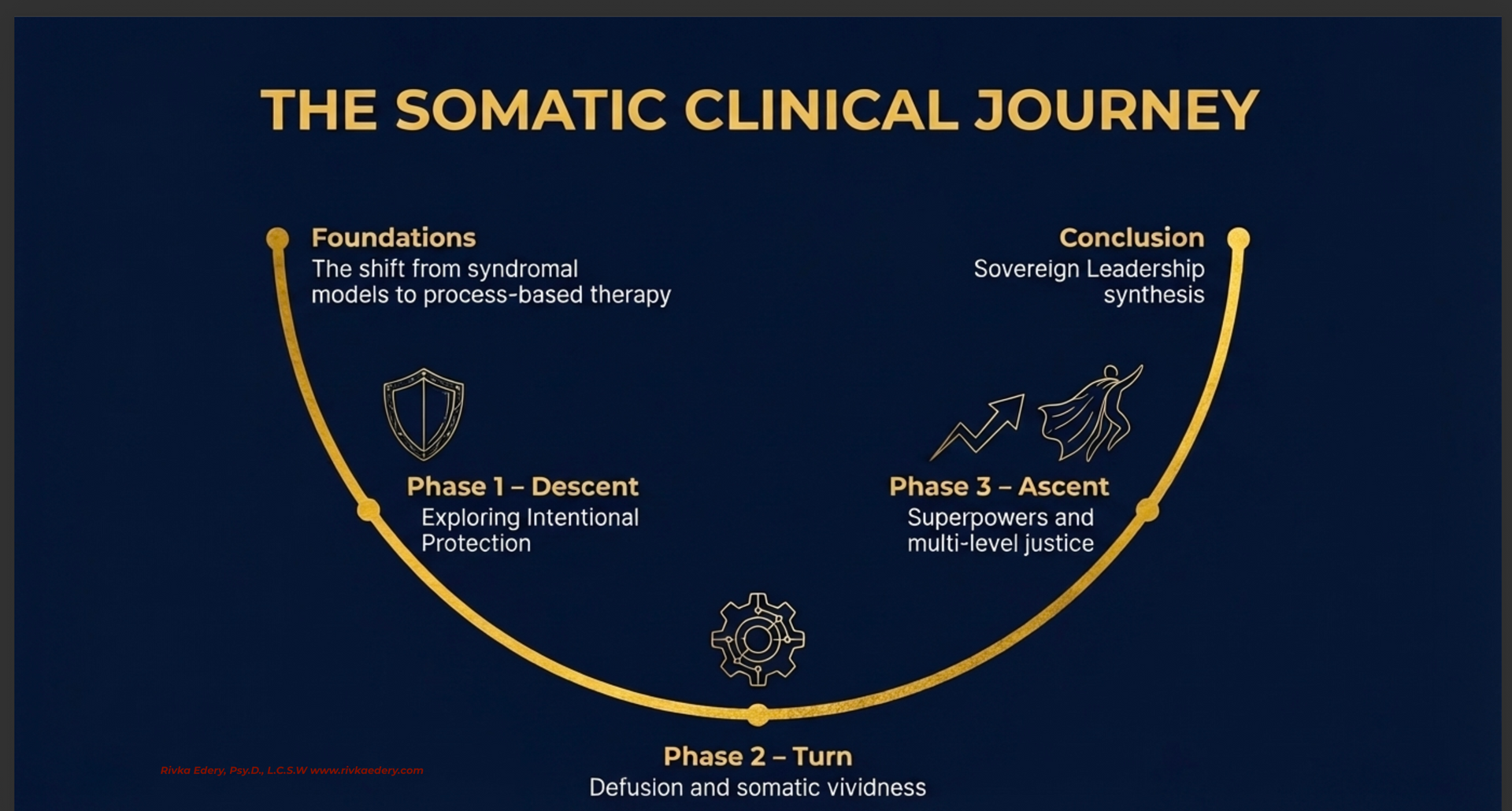
The U-Model™ provides a sequential roadmap that facilitates descent into deep parts work (IFS) and ascent into functional life change (ACT). This protocol ensures that "Self-energy" is translated into measurable behavioral health outcomes.
- Stage 1: Initial Assessment - Mapping the "Inner Platoon" of protective parts and identifying systemic/cultural burdens.
- Stage 2: Present Moment Contact - Establishing an "Anchor of Self" to maintain grounding before engaging exiled material.
- Stage 3: Acceptance - Expanding the clinical "window of tolerance" to hold somatic distress without flooded reactivity.
- Stage 4: Cognitive Defusion - Delinking the Self from the rigid mandates, rules, and "truths" of the protective system.
- Stage 5: Values Clarification - Distinguishing the core desires of the Self from trauma-driven survival goals.
- Stage 6: Committed Action - Implementing tangible behavioral shifts that honor the newly unburdened internal system.
- Stage 7: Recycling - Utilizing setbacks and "protector-re-engagement" as functional feedback loops within the recovery cycle.
Clinical Research & Evidence-Informed Design
The U-Model™ is not a static theory; it is a dynamic framework anchored in the rigorous meta-analysis of the "Death Star Project" (Hayes et al., 2020). By targeting the specific mediators of clinical improvement- psychological flexibility and affective regulation - the framework ensures that every intervention is grounded in the science of human change.
- Incoherent Grief: Somatic Residue in Pre-Verbal Survivors: Presented at the Forgotten Voices International Conference (Kraków, April 2026). This research utilizes the U-Model™ to navigate "non-narrative" trauma, addressing existential guilt and somatic "residue" in survivors of pre-verbal systemic persecution (ages 0–4).
- The Death Star Project Alignment: A technical analysis evaluating the U-Model™ against the core competencies of Process-Based Therapy (PBT). This work bridges the gap between intra-psychic parts-work and the measurable mediators required for lasting therapeutic outcomes.
- Macro-Contextual Protective Parts: An innovative framework for identifying how historical trauma, systemic oppression, and cultural burdens manifest as internal "Protectors" within the IFS system.
FAQ: The Science Behind the U-Model™ (ACT + IFS)
How significant are the trauma remission results?
In a pilot study of adults who survived multiple childhood traumas, 92% of participants no longer met the clinical criteria for PTSD one month after treatment. The study reported a very large effect size (d = -4.46) on the Clinician-Administered PTSD Scale (CAPS).
Reference: Hodgdon, H. B., Anderson, F. G., Southwell, E., Hrubec, W., & Schwartz, R. (2022). Internal Family Systems (IFS) therapy for posttraumatic stress disorder (PTSD) among survivors of multiple childhood trauma: A pilot effectiveness study. Journal of Aggression, Maltreatment & Trauma, 31(1), 22–43. https://doi.org/10.1080/10926771.2021.2013375
What is the "Death Star Project"?
The reference for the "Death Star Project" is a foundational 2020 paper by Steven C. Hayes, Stefan G. Hofmann, and Joseph Ciarrochi. This project represents a major scientific shift from traditional syndromal diagnostics (group-average laws) toward idionomic modeling, which maps the specific psychological wiring of an individual’s unique psyche.
Why focus on "Idionomic Modeling"?
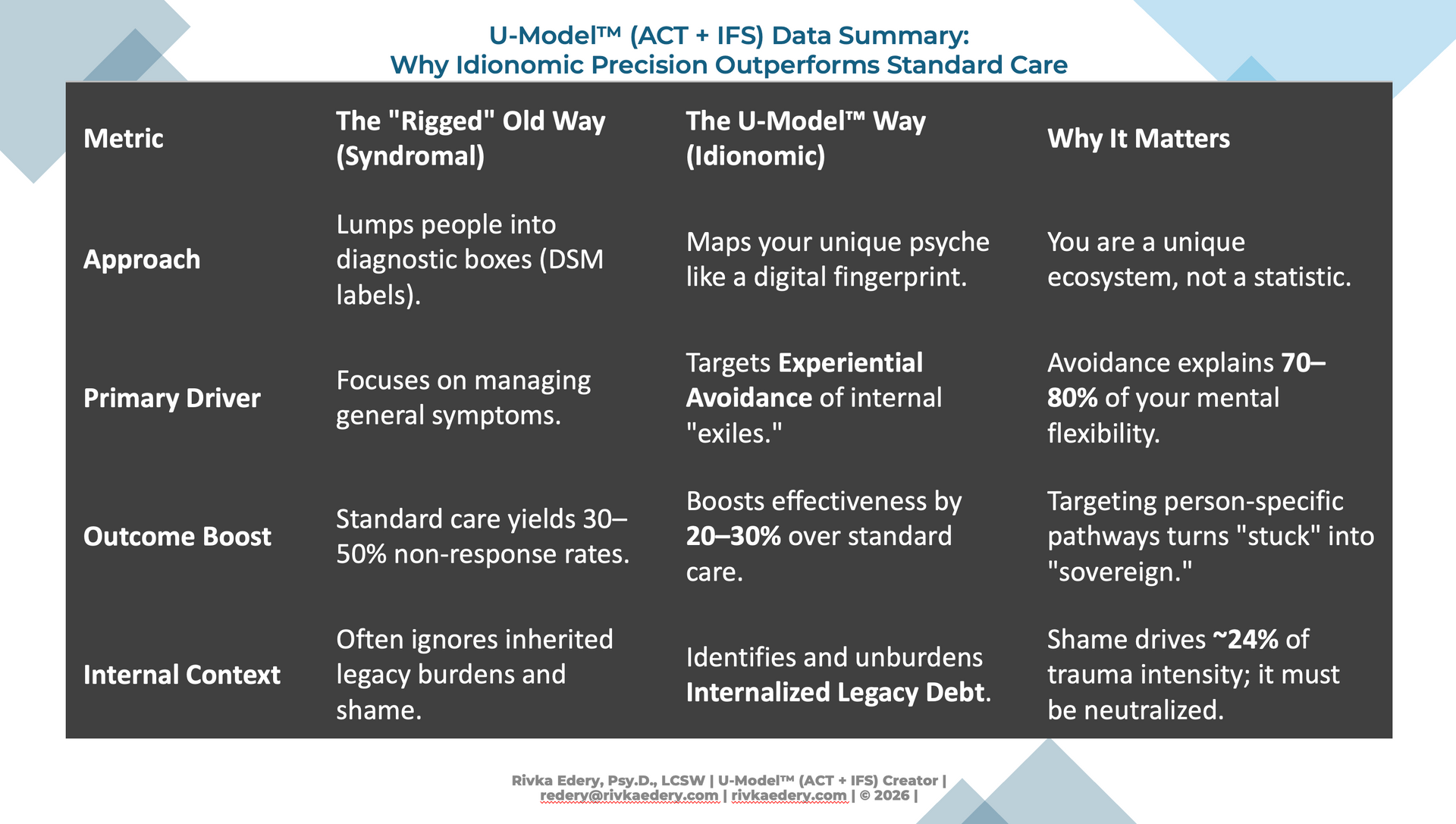
Traditional "syndromal" diagnostics lump people into general categories, but idionomic modeling maps the specific wiring of an individual's psyche like a digital fingerprint . This personalized approach can boost outcomes by 20–30% over standard care.
Key Scientific Contributions of the Death Star Project:
- Dismantling Syndromal Boxes: The project involved over 50 researchers working to move psychology away from outdated diagnostic labels (like those in the DSM) that treat patients as statistics.
- Personalized Precision: It focuses on targeting person-specific pathways, which research indicates can boost treatment outcomes by 20–30% over standard care.
- Identifying Mediators: A primary finding of this idionomic research is that "exile avoidance" (experiential avoidance) is a powerhouse mediator explaining 70–80% of the variance in a person's psychological flexibility.
Reference: Hayes, S. C., Hofmann, S. G., & Ciarrochi, J. (2020). A process-based approach to psychological diagnosis and treatment: The conceptual and treatment utility of an extended evolutionary meta model.
Clinical Psychology Review, 82, Article 101908. https://doi.org/10.1016/j.cpr.2020.101908
What is the role of shame in trauma treatment?
Shame is a critical factor that explains approximately 24% of PTSD symptom intensity. The U-Model™ (ACT + IFS) targets neutralizing this internal contempt to unlock "stolen fuel" for recovery.
Reference: DeCou, C. R., Lynch, S. M., Weber, S., Richner, D., Mozafari, A., Huggins, H., & Perschon, B. (2023). On the association between trauma-related shame and symptoms of psychopathology: A meta-analysis. Trauma, Violence, & Abuse, 24(3), 1193–1201. https://doi.org/10.1177/15248380211053617
How does the U-Model™ (ACT + IFS) prevent practitioner burnout?
By scaling actions across Micro, Meso, and Macro levels and utilizing somatic release, practitioners have reported a reduction in burnout of over 50%.
Reference: Ally, D., Tobiasz-Veltz, L., Tu, K., Comeau, A., Bumpus, C., Blot, T., Rice, F. K., Orr, B., Soumerai Rea, H., Sweezy, M., & Schuman-Olivier, Z. (2025). A pilot study of an online group-based Internal Family Systems intervention for comorbid posttraumatic stress disorder and substance use. Frontiers in Psychiatry, 16, Article 1544435. https://doi.org/10.3389/fpsyt.2025.1544435
Apply the U-Model™: View Training & CE Archives
https://www.rivkaedery.com/training_and_CE