The Edery Report: News & Insights
Clinical Intelligence & Leadership Briefings from Dr. Rivka Edery
This space exists for one purpose: to give practitioners a clear, useful synthesis of Internal Family Systems (IFS) and Acceptance and Commitment Therapy (ACT) — anchored in the universal mediators of change rather than any single brand-name protocol. This year, I'm focused on rolling out the U-Model™ globally, a 7-stage framework that treats the mind as a dynamic internal family and guides clients from trauma-driven reactivity to values-aligned action.
-Dr. Rivka Edery, Psy.D., LCSW
The U-Model™ Parts Now Have Faces!
Meet Niggle, Skitch, and VelFire - the three parts at the heart of The U-Model™, now with their official portraits.
There's a gentle tapper, a quick deflector, a tender gift-carrier… and one affectionate pair name, Skitch-A-Niggle, you'll recognize from the workbook.
Meet all four → /meet-the-parts
New Live Webinar Series: Detecting Deception as a Healing Tool
New Live Webinar Series: Detecting Deception as a Healing Tool
A child says something untrue, and a flicker on their face gives it away. That flicker is a leak, and behind it, a protective part does its best to keep the child safe.
In partnership with A Home Within, this free four-part series explores why lying and concealment are adaptive protection rather than defiance, and how to shift from "what really happened" to creating safety. 2 CE credits per session. Each part has its own registration.
Part 1: Wednesday, October 21 at 2:45 PM PT / 5:45 PM ET
Register for Part 1: https://www.ahomewithin.org/events/detecting-deception-as-a-healing-tool-a-u-model-approach-for-foster-youth-part-1/
All four dates: https://www.rivkaedery.com/training_and_CE
Stop chasing the leak. Start meeting the parts that lie to protect.
NEW: The Inner Minyan,
a Community and Directory for Jewish Therapists and IFS Practitioners
Many of us carry two identities at once: clinicians who work with parts, and Jews who carry a long, complicated, beautiful inheritance. We rarely have a room where both can show up together.
The Inner Minyan is that room. It's a peer-led community with a WhatsApp group for everyday conversation, questions, and support, and a monthly Zoom with a community-led opening and closing meditation. Cameras are on, registration is required, and we don't record sessions. Our first Zoom is Sunday, November 8, at 3:00 PM ET.
There's also a free directory. If you're looking for an IFS-trained Jewish therapist, you can search it here:
https://www.innerminyan.org/find-a-therapist
If you're a therapist, the directory is brand new, and you can be one of the first listed:
https://www.innerminyan.org/apply-to-be-listed
To join the community, send a request here:
https://www.rivkaedery.com/the-inner-minyan
Ten is a minyan. We're aiming a little higher.
Recognition & Service
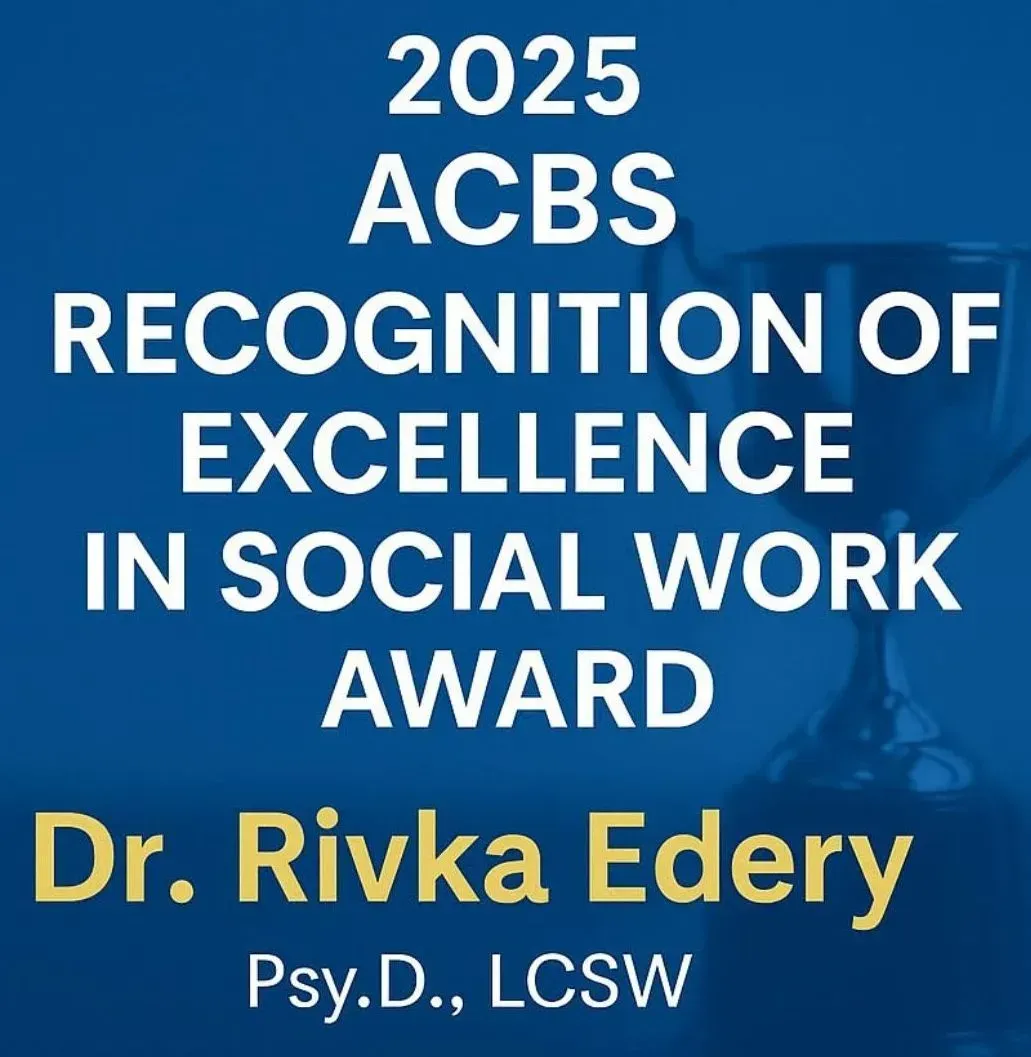
2025 ACBS Recognition of Excellence, awarded for contributions to social work and Contextual Behavioral Science. I currently serve as a Grant Reviewer for the ACBS Foundation and an Abstract Reviewer for the 2026 NASW National Conference.
Leading with Self-Energy: Reimagining Institutional Resilience in Social Work
Leadership in our field is often viewed through the lens of administration and policy alone—but the future of social work requires deeper integration of clinical intelligence and institutional governance.
Recent research on US medical social workers reaches the same conclusion: moral injury is now recognized as a distinct, serious threat to workforce resilience—one that requires its own targeted response, not just generic burnout prevention. Burnout asks us to rest. Moral injury asks something harder: it asks the system itself to change.
Three pillars guide this work. First, we bridge the research-practice gap by using universal mediators, psychological flexibility and affective regulation, to train and support clinicians. Second, we address moral injury directly: structured, self-led coping programs have shown measurable improvement in moral injury symptoms for a meaningful share of participants, showing this is not an intractable condition. Third, apply psychological flexibility to governance itself: calm, clarity, curiosity, compassion, confidence, courage, creativity, connection, and values-based committed action, as principles for how institutions lead and advocate for their members.
A Self-Leadership initiative built on these principles can help social workers unblend from the "Rescuer" parts that drive moral injury, override fatigue and limits, and ultimately undermine the self. The pattern across our field is consistent: systems that don't give back exhaust social workers. The path forward is "Clinical Governance" - treating clinician unburdening as a systemic necessity, not a personal luxury.
References:
Fantus, S., et al. (2024). Confronting moral injury across health systems: Enhancing medical social workers' resilience and well-being. Stress and Health. DOI: 10.1002/smi.3485.
Kirchner, K., Persaud, P., Bland, C., & Sherman, H. (2026). Moral injury in healthcare workers: An intervention to mitigate distress. DOI: 10.1177/09697330261449301
The U-Model™ in Practice
The model moves through three movements. The Descent (Phases 1–2) identifies the "Inner Platoon" - Managers and Firefighters - and anchors the client in Self. The Trough (Phases 3–4) achieves empathic resonance and present-moment acceptance at the base of the U. The Ascent (Phases 5–7) leads with Self-energy toward values-driven action.
Two parts often appear in this work. The "Niggle" (Manager) drives persistent self-criticism; the "Skitch" (Firefighter) drives high-arousal reactive impulses - and in ethical dilemmas, often takes over to "put out the fire" of moral injury. True ethical leadership requires the Self to acknowledge the Skitch's protective intent before making a values-based move.
Research I presented at the 2026 Kraków Conference revealed that "Exile" parts often communicate through pre-verbal somatic pressure rather than narrative - what we call "Incoherent Grief" in the U-Model™. Clinical success in this phase depends on the therapist's ability to witness that pressure without a cognitive agenda. This framework builds on the Hayes et al. (2020) meta-analysis, which found that therapeutic success rests on universal mediators rather than brand-name protocols.
Weekly Wisdom: The Architecture of Resilience
We often mistake numbness for resilience.
True resilience isn't the absence of our parts' reactions - it's the presence of Self-energy.
Resilience isn't about evicting a Skitch part; it's the Self's capacity to witness the fire's heat without becoming the smoke. If you're breathing through the smoke, you're still in the lead.
When a client's system is flooded, don't hunt for a story - find a neutral somatic anchor.
I often ask: "Can you feel the specific texture of the chair against your shoulder blades?"
This bypasses the cognitive Manager and speaks directly to the nervous system.
"The most powerful relationship you will ever have is the relationship between your Self and your Parts." -the foundational thesis of Edery House Press.
"The Skitch isn't the enemy. It's a fire alarm with a very big heart."
- the U-Model™ mantra for befriending the loudest part.
A question for your week:
Your fire alarm has probably gone off many times before your Self ever showed up.
This week, when it rings, can you stay beside it instead of silencing it?
Ask what it needs from you before it could ever trust you with the wheel.
Resources & Community
Between Self and Parts: A 30-Day Journey with The U Model™ is available through Edery House Press. The Clinical Voice Series offers audio briefings and worksheets for certification cohorts, including modules on the Niggle/Skitch system and on tracking Incoherent Grief and pre-verbal trauma markers.
Join the monthly IFS Fireside Gatherings - a community practicing Self-to-Part connection and co-regulation — via Zoom
(https://us06web.zoom.us/meeting/register/8_08b8YgQc6Ei3Ib-K6c8Q)
Facebook group, Beyond Acceptance: Your Inner Parts Welcome to an ACT & IFS Community (https://www.facebook.com/share/utKN6WT4Bgp6gAtW/).
Words to Carry
"I am not my Parts. My Parts are not me."
"Parts are not their burdens."
"All parts have wisdom - Self unlocks it."
Dr. Rivka Edery, Psy.D., L.C.S.W., M-RAS, IFS Level I
Program Assistant, IFS Institute
Tel: +1 (361) 704-4051 | Email: redery@rivkaedery.com | Website: www.rivkaedery.com
Subscribe: http://eepurl.com/h8n6az